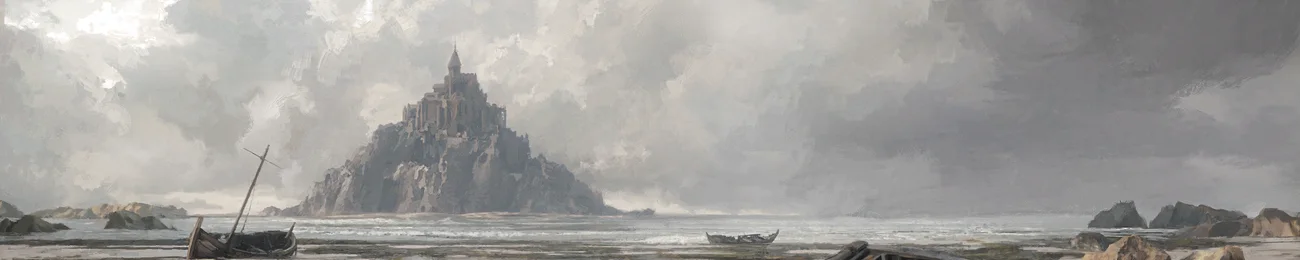

Lore · Epic
Valon Marsh
Read this whilst in the Chateau to add it to your Compendium and earn Experience.
A small handwritten note.
Full text
Extracted from A Regional Survey of the Western Littoral and Adjacent Territories, compiled for officers of the Treaty and travelling persons.
Among the western territories lying beyond the principal roads of Valon, few districts possess a reputation so consistently ill-favoured as the region commonly termed the Valon Marshes. Extending along the western shoreline beneath a chain of low coastal rises, the district consists of flooded peatlands, stagnant channels, reed fields and innumerable islands of uncertain ground, many of which appear and disappear according to season and tide.
The Marshes possess no single centre of habitation. Rather they consist of scattered hamlets, peat-cutting settlements, fishing villages and isolated trading posts connected by narrow raised roads and timber causeways. Travellers unfamiliar with the district are advised against independent passage, for local paths frequently terminate without warning in flooded ground, sinkwater, or channels of unexpected depth.
For several centuries the district acquired notoriety as a refuge for smugglers, brigands and those classes of men inclined toward evasion of ordinary authority. The terrain itself proved a natural accomplice. Concealed waterways permitted movement unseen from the roads, whilst thick reeds and low mists rendered pursuit difficult even under favourable conditions.
It was principally for this reason that during the seventeenth century the Crown authorised construction of Fort Morvain upon the coast overlooking both the western channel and principal marsh approaches. The fortress served as a military station intended to suppress illicit traffic and deny free passage to privateers and contraband traders operating between the coast and interior settlements.
Though Fort Morvain maintained some success in controlling maritime activity, the interior Marshes proved less obedient. Successive garrisons discovered that brigands expelled from one district merely vanished into another. Numerous officers noted with irritation that local inhabitants often displayed loyalties considerably more flexible than official reports preferred to acknowledge.
Since the End, conditions have deteriorated to an extraordinary degree.
Many of the old settlements now stand abandoned or ruined. Causeways have collapsed. Trading stations lie overgrown and silent. Such order as once existed has yielded to slavers, cannibal bands, and opportunists who conduct raids upon roads approaching the district. Reports persist of travellers seized from isolated routes and carried into the interior, after which neither victim nor captor is commonly seen again.
Among the settlements formerly serving the district, none is more frequently remarked upon than the hamlet of Mireval, situated near the central peat channels and formerly responsible for supplying labour, provisions and transport services to Fort Morvain and several adjacent cutting quarries.
Prior to the End, Mireval was regarded as unremarkable save for its position and industry. The settlement maintained peat cutters, ferrymen and labouring families whose work supported much of the surrounding marsh infrastructure. Owing to its northern position and defensible approaches, the village possessed advantages uncommon to the district and appears to have weathered the earliest calamities better than many neighbouring settlements.
Indeed, the last consistent reports concerning Mireval suggested conditions of unusual stability. Local correspondence spoke of barricades erected upon the roads, fortified dwellings, watch rotations and rationing measures instituted under village leadership. Several accounts further indicate that refugees from smaller settlements had begun arriving there in considerable number.
Thereafter the record grows uncertain.
At some point during the early years following the End, Mireval was destroyed entirely by fire.
The cause remains disputed.
Neither military dispatches nor surviving accounts provide any satisfactory explanation. Certain reports attribute the destruction to Hunger incursions, others to slavers operating within the region, whilst more imaginative persons maintain the inhabitants themselves set flame to the settlement for reasons now lost.
Whatever the truth, present conditions furnish little evidence. The village today stands blackened and abandoned, its outer structures collapsed and consumed. Only the central tower remains substantially intact.
Patrols passing near Mireval have repeatedly noted an unusual reluctance among local guides to approach its roads after dusk. Such behaviour among marsh inhabitants is sufficiently uncommon to warrant notation.
Certain accounts further describe the emergence of entities peculiar to the Marshes, now collectively referred to by local inhabitants as Wombs.
The origin of these creatures remains disputed. Accounts gathered from survivors and intercepted slavers suggest a practice of singular barbarity conducted deep within inaccessible portions of the swamp. Though details vary considerably between testimonies, sufficient consistency exists to render dismissal imprudent. Investigation parties sent to verify such reports have seldom returned with findings of value.
The creatures themselves are said to remain partially concealed amidst reeds and flooded growth until approached, whereupon they exhibit extreme aggression. Patrol records indicate casualty rates disproportionate even among experienced detachments.
Political authority within the district likewise remains contested.
The Valon Gendarmerie continues intermittent operations along the principal roads and settlements surrounding the Marshes, though their influence rarely extends far into the flooded interior. By contrast, the Mire Cartel - long associated with smuggling and illicit trade throughout the region - moves through the Marshes with a familiarity bordering upon proprietorship.
Curiously, despite their criminal reputation, Cartel detachments have on multiple occasions been observed conducting violent actions against slaver groups and cannibal settlements. Such actions should not be mistaken for benevolence. The Cartel's longstanding conflict with the Gendarmerie, combined with its preference for maintaining control over its own territories and commerce, appears explanation enough.
Thus one arrives at the singular circumstance now prevailing within Valon: that the Marshes remain among the few districts where a man may discover brigands acting as executioners, lawmen advancing by inches, and slavers hunted by both.
Few territories furnish so poor a choice of allies.
More lore

Hunger Playtest 5.0 (Steam build 26055891). Updated 2026-10-20. Numbers can change before release. Rarity follows the item's ID. Prices and stack sizes are not listed yet for this build. Maintained by Lynxx.